Friday Ushering in of the Shabbat: 6pm - 8pm
Shabbat Service Open: 9am - 8pm

The Dietary Laws of the Torah
- Home
- /
- / The Dietary Laws of the Torah
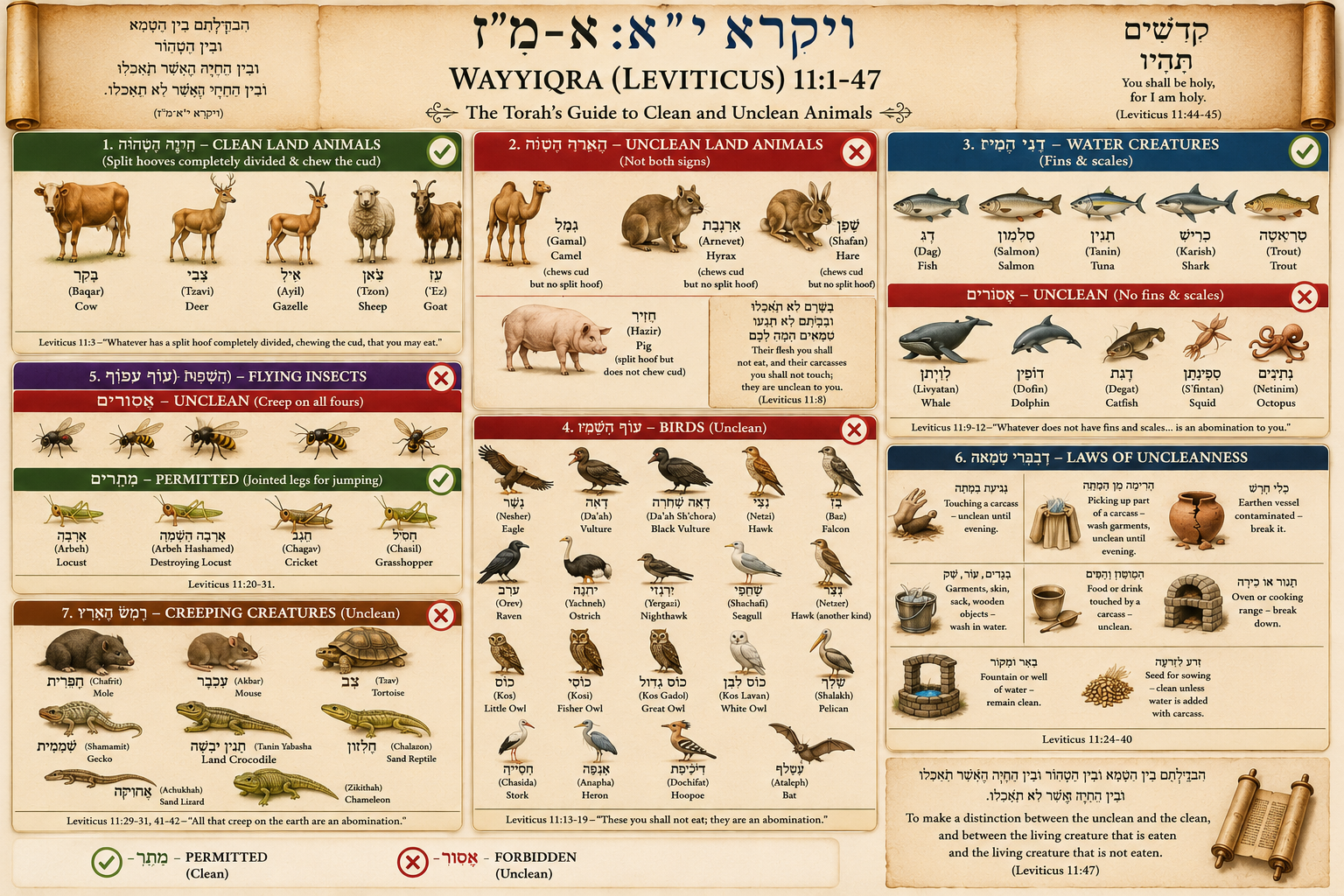
A Deep and Human Teaching on Wayyiqra (Leviticus) 11:1–47
For someone beginning to walk in the Torah, Wayyiqra 11 can initially feel like a long list of animals, birds, insects, carcasses, and rules about uncleanness. But when we slow down and listen to the chapter as a whole, something beautiful emerges.
This chapter is not merely about what is on your plate.
It is about learning to distinguish.
It teaches Israel to look at the world carefully, to recognize boundaries, to respect what Elohim has declared clean and unclean, and ultimately to cultivate a life of qodesh (holiness).
The central message comes near the end:
“For I am YHWH your Elohim, and you shall qadosh yourselves. And you shall be qodesh, for I am qodesh.”
— Wayyiqra 11:44
That is the heart of the chapter.
First, Understand the Purpose
A person may ask:
“Why would Elohim care what animal I eat?”
That is a very natural question.
We often think of food simply as something that satisfies hunger. We go to the market, buy meat, fish, vegetables, rice, or other foods, prepare them, and eat.
But Torah teaches us that eating can also become an act of obedience.
Think about it this way:
A person can go through an entire day without consciously thinking about holiness. But everyone eventually has to eat.
Therefore, food becomes one of the simplest ways to bring obedience to Elohim into ordinary daily life.
You are hungry.
You prepare your meal.
You look at what is before you.
And you remember:
“I belong to Elohim. I do not decide everything according to my appetite. I receive His instruction.”
That is a profound spiritual discipline.
The Meaning of “Clean” and “Unclean”
One of the most important things for a new student of Torah is to understand that clean and unclean are not simply synonyms for good and evil.
The Hebrew concepts are:
An animal being classified as tamei does not mean the animal is morally evil.
A pig is not a sinful creature.
A cat is not wicked.
A vulture has not committed a moral crime.
The classification concerns the ritual and dietary order established by Elohim for Israel.
This distinction is extremely important.
The First Principle: The Torah Teaches Distinction
Look at the final verse:
“To make a distinction between the unclean and the clean, and between the living creature that is eaten and the living creature that is not eaten.”
— Wayyiqra 11:47
The word distinction is extremely important.
Torah repeatedly teaches Israel to distinguish:
This is part of the education of Israel.
A Torah-observant person learns not merely:
“Can I do this?”
but:
“What has Elohim taught me to distinguish?”
That is a different way of living.
Land Animals — Wayyiqra 11:3
YHWH gives Israel a very clear identifying principle for land animals:
“Whatever has a split hoof completely divided, chewing the cud, among the beasts, that you do eat.”
There are therefore two identifying signs.
Sign 1: Completely divided hoof
The animal must have a properly divided, split hoof.
Sign 2: Chewing the cud
The animal must chew the cud.
Both characteristics are required.
This is important:
One sign is not enough.
The animal must satisfy the Torah's criteria.
The Four Famous Examples
The Torah then gives examples.
The Camel
The camel chews the cud but does not have the required divided hoof.
Therefore:
Not permitted.
The Rabbit/Hare
The text describes it as chewing the cud but lacking the required hoof characteristic.
Therefore:
Not permitted.
The Pig
This is probably the most famous example.
The pig has a completely divided hoof.
But it does not chew the cud.
Therefore:
Not permitted.
The pig teaches an important lesson.
It possesses one characteristic without the other.
That is why Torah requires both.
A Spiritual Lesson from the Pig
We should be careful here.
The Torah itself does not say:
“The pig represents hypocritical people.”
That would be an interpretation imposed upon the text.
But we can legitimately draw a spiritual reflection from the principle.
A person should not say:
“I have one sign, therefore I am obedient.”
Torah obedience is not about selecting the commandments we like while ignoring the others.
The pig demonstrates the importance of complete identification according to the Torah's criteria.
This can humble us.
It reminds us:
I do not define obedience by my own standards. Elohim defines the boundaries.
Fish and Creatures of the Waters
Wayyiqra (Leviticus) 11:9 gives another simple rule:
“Any one that has fins and scales in the waters... that you do eat.”
Again, the Torah provides identifying characteristics.
Permitted aquatic creatures:
Fins + scales
Not permitted:
Creatures lacking these characteristics.
Therefore, traditional kosher practice excludes creatures such as:
The principle is not:
“Does this seafood taste good?”
It is:
“Does this creature meet the signs established by the Torah?”
Why Does Torah Give Signs?
This is a beautiful feature of the passage.
Elohim does not merely give Israel a random shopping list.
He gives recognizable characteristics.
The Israelite is taught to examine creation.
Look at the animal.
Look at its feet.
Look at its feeding characteristics.
Look at the fish.
Look at its fins and scales.
In other words:
Torah trains the eyes before it trains the appetite.
That is profound.
Before you put something into your body, you learn to ask:
“What is this?”
Birds
The bird section is somewhat different.
Instead of giving one simple physical sign like “fins and scales,” Wayyiqra (Leviticus) 11 lists birds that Israel is not to eat.
The list includes various birds of prey and carrion-eating birds, including:
The traditional Jewish understanding preserves the Torah's prohibition through established identification and tradition.
This is one reason Jewish dietary law eventually developed careful traditions concerning the identification of kosher birds.
Why Are Birds of Prey Significant?
Again, we must distinguish Torah commandment from later interpretation.
The Torah does not explicitly say:
“These birds are forbidden because they are violent.”
Nevertheless, many of the listed birds are predatory or associated with carrion.
This gives us an interesting picture.
The Torah is not simply interested in whether something can physically be eaten.
It establishes a particular dietary order for Israel.
The obedient Israelite does not need to invent a philosophical explanation for every individual prohibition before obeying it.
Sometimes the proper response is simply:
“Ha-Kadosh Baruk Hu has commanded it; therefore I will honor His instruction.”
That is called emunah — faithfulness.
Insects and Locusts
This section often surprises people.
Wayyiqra (Leviticus) 11:20 says flying insects that move on all fours are generally forbidden.
But there is an exception.
Certain kinds of locusts are permitted.
The Torah specifically mentions:
This demonstrates something important:
Torah dietary law is more precise than simply saying “all insects are forbidden.”
There is a specific exception.
However, identifying the exact species has historically depended upon preserved Jewish tradition.
Consequently, communities that do not possess an unbroken tradition identifying particular locust species generally do not eat them.
Carcasses: The Torah Is Also Concerned with Contact
Now we reach an important distinction.
Wayyiqra (Leviticus) 11 is not exclusively about eating.
It also discusses contact with dead animals.
For example:
“Anyone touching the carcass... is unclean until evening.”
This is the concept of tamei.
A person could become ritually unclean without committing a moral sin.
This is extremely important for new converts.
Ritual impurity ≠ moral wickedness
If an Israelite accidentally touched a dead animal, that did not mean:
“You are an evil person.”
Rather, the person entered a temporary ritual state.
The Torah provided procedures associated with purification.
Why Does the Torah Care About Carcasses?
The Torah repeatedly emphasizes death.
A dead creature is different from a living creature.
This may be connected to the larger scriptural concern with life, death, holiness, and the sanctuary.
Israel was being formed as a people capable of approaching the presence of Elohim according to His appointed order.
Therefore, questions of ritual purity mattered.
This becomes especially significant when studying the Mishkan and later Temple service.
The Earthen Vessel
Verse 33 says that if the carcass falls into an earthen vessel:
“You break it.”
Why?
Because the Torah treats the vessel differently from certain other materials.
The earthenware vessel cannot simply be purified in the same manner as some other objects.
So the vessel is broken.
For a modern reader, this can sound extreme.
But imagine the ancient Israelite household.
You have a cooking vessel.
A forbidden carcass falls inside.
You cannot simply ignore it.
You cannot say:
“It's probably fine.”
The Torah teaches:
Purity requires deliberate attention.
What About Food?
Verse 34 says that food upon which water comes and which is then contacted by such impurity becomes unclean.
This shows how carefully the Torah considers the relationship between:
water + food + contact + ritual status.
These regulations are part of a larger scriptural system of ritual purity.
The ancient Israelite household therefore becomes a place where holiness is practiced in practical ways.
Wells and Living Water
There is an interesting exception:
“But a fountain or a well, a collection of water, is clean...”
Water has an important place throughout Torah.
Water is repeatedly associated with:
This becomes increasingly meaningful when the Torah's purification laws are studied as a whole.
Seeds and Agriculture
The Torah even discusses seeds.
If the carcass falls upon dry planting seed, it remains clean.
But if water has been placed upon the seed and then the carcass falls upon it, it becomes unclean.
This may seem like an extremely small detail.
But that is precisely the point.
Torah holiness reaches into ordinary life.
Not only the synagogue.
Not only prayer.
Not only sacrifices.
But:
Holiness is not merely a religious ceremony.
It becomes a way of life.
The Torah's Repeated Message: “Do Not Eat”
Throughout this chapter, the repeated instruction is clear:
You shall not eat them.
This is the dietary boundary.
For a person entering Torah observance, this can require significant changes.
You may discover that some foods you grew up eating are not permitted.
Perhaps you grew up eating pork.
Perhaps seafood was a normal part of family meals.
Perhaps you never thought twice about what type of fish was on your plate.
Now you are learning Torah.
The temptation may be to feel overwhelmed.
But do not despair.
Torah is learned one commandment at a time.
Do Not Turn Torah Into Fear
A person should not live in constant anxiety:
“Did I accidentally become unclean?”
“Did I touch something?”
“Is my kitchen perfect?”
“Did I make a mistake?”
Torah observance should produce faithfulness, not obsessive terror.
Learn carefully.
Ask questions.
Study the halakhic tradition.
Correct mistakes when you discover them.
And continue walking.
A person learning Torah is a student.
And students learn.
The Most Important Question: Why?
By verse 44, Elohim reveals the deeper reason:
“For I am YHWH your Elohim, and you shall qadosh yourselves. And you shall be qodesh, for I am qodesh.”
Notice something beautiful.
Ha-Kadosh Baruk Hu does not say:
“Keep these dietary laws because food is bad.”
He says:
“I am your Elohim.”
Then:
“You shall be qodesh.”
Then:
“For I am qodesh.”
The command is connected to relationship.
Holiness Is About Belonging
The word qadosh means “holy,” “set apart,” or “consecrated.”
Israel was called to be different because Israel belonged to Elohim.
This is one of the foundational ideas of Torah.
You don't observe Torah merely to become a morally superior person.
You observe because:
“I belong to Him.”
That changes everything.
When a Yahudi (Jew) chooses kosher food, the action can become a declaration:
“My appetite does not own me. YHWH is my Elohim.”
“I Brought You Out of Egypt”
Verse 45 says:
“For I am YHWH who is bringing you up out of the land of Mitsrayim, to be your Elohim.”
This is deeply important.
The dietary laws are connected to the Exodus.
Why?
Because Israel's identity began with redemption.
Elohim says, essentially:
“I brought you out. You belong to Me. Therefore, live according to My holiness.”
This pattern occurs repeatedly throughout Torah.
Redemption → relationship → obedience → holiness.
Israel does not obey in order to make Ha-Kadosh Baruk Hu become their Elohim.
Elohim first establishes His relationship with Israel and then teaches them how His people are to live.
Dietary Laws Are Not About Earning Salvation
This is an important lesson for anyone coming from a different religious background.
Keeping dietary laws does not mean:
“If I eat kosher food, I have earned eternal life.”
That is not what Wayyiqra (Leviticus) 11 teaches.
The chapter teaches obedience to the covenantal instruction of Ha-Kadosh Baruk Hu.
Food does not magically make a person righteous.
A person can eat permitted food while behaving terribly toward other people.
That would completely miss the larger Torah.
Holiness includes how we treat:
Kosher food is not a substitute for righteousness.
It is one dimension of a Torah-shaped life.
“I Am Qadosh”
Perhaps the most powerful statement in the entire chapter is:
“You shall be qodesh, for I am qodesh.”
The standard is not:
“Be holy because other people are holy.”
It is:
“Be holy because I am holy.”
Ha-Kadosh Baruk Hu Himself is the standard.
That means holiness begins with recognizing who He is.
Dietary Discipline Trains the Heart
Imagine sitting at a restaurant.
You see something you really enjoy.
But then you realize:
“This is not permitted according to the Torah.”
You have a choice.
Nobody may be watching.
Nobody may know.
You could eat it secretly.
But you don't.
Why?
Because your obedience is not ultimately to people.
It is to Elohim.
That moment can become a powerful spiritual exercise.
You have just practiced:
self-control, remembrance, obedience, and covenant faithfulness.
Torah Does Not Say Every Forbidden Animal Is “Bad”
This is another important correction.
The pig is not evil.
The shrimp is not evil.
The eagle is not evil.
The lizard is not evil.
They are creatures of Elohim.
The prohibition concerns their use as food within the Torah's dietary system.
This distinction protects us from unnecessary hatred toward creation.
We can appreciate the beauty of an animal without eating it.
In fact, Torah teaches reverence for creation while simultaneously establishing boundaries concerning how Israel interacts with it.
Clean Does Not Mean “More Valuable”
Another common misunderstanding is:
“If a cow is clean and a pig is unclean, does that mean cows are spiritually better animals?”
No.
The Torah is not establishing a ranking of animal worth.
It is establishing dietary and ritual categories.
A clean animal is not necessarily morally superior to an unclean animal.
The categories serve the covenantal purposes of the Torah.
Why Does Torah Give So Much Detail?
Because holiness requires attention.
Look at how detailed this chapter is.
Elohim discusses:
This teaches us something about Torah itself.
Elohim is interested in how His people live.
Not merely what they believe.
Not merely what they say.
But how they conduct ordinary life.
The Torah Trains Us Not to Live by Appetite Alone
Human beings often live according to:
“I want it, therefore I eat it.”
Torah introduces another question:
“Is it permitted?”
That is a fundamental spiritual discipline.
Our desires are real, but they are not our ultimate authority.
For the Torah-observant person:
desire comes under instruction.
This is one of the reasons dietary commandments can become spiritually powerful.
What Should a New Convert Actually Do?
If you are newly beginning to observe the Torah, do not panic.
Start by learning the basic framework.
Learn these four categories:
1. Land animals
Split hoof + chewing cud.
2. Aquatic animals
Fins + scales.
3. Birds
Follow the Torah's prohibited list and established Jewish identification traditions.
4. Insects
Generally prohibited, with specific locust exceptions preserved through tradition.
Then begin learning the practical laws of kashrut.
Kashrut Goes Beyond Leviticus 11
This is extremely important.
Wayyiqra 11 is foundational, but the complete Jewish dietary system is not contained in this chapter alone.
Other Torah passages are essential.
For example:
Shemot (Exodus) 23:19
“You shall not boil a young goat in its mother's milk.”
Shemot (Exodus) 34:26
The same principle is repeated.
Devarim (Deuteronomy) 14
Devarim (Deuteronomy) gives another major presentation of the dietary laws.
Wayyiqra (Leviticus) 17
Wayyiqra (Leviticus) discusses the prohibition concerning consuming blood.
Therefore, someone studying kashrut seriously should study these passages together.
Blood Is a Separate and Major Torah Principle
Wayyiqra (Leviticus) 17:11 says:
“For the life of the flesh is in the blood.”
This becomes extremely important in understanding Jewish slaughter and preparation of meat.
The Torah prohibits consuming blood.
Therefore, traditional Jewish kashrut includes procedures intended to remove blood from permitted animals.
This eventually becomes associated with practices such as:
These practical laws developed within Jewish halakhic tradition from the Torah's commandments.
What Is Kosher?
The word kosher comes from the Hebrew root כ־ש־ר and means something like:
fit, proper, suitable.
So when Jews speak of kosher food, they mean food that is considered fit according to Jewish dietary law.
The opposite is commonly called:
treif / treifah — something prohibited or torn/non-permitted, depending on context.
Therefore, “kosher” is not simply another word for “healthy.”
A food can be nutritionally healthy and still not be kosher.
And something kosher is not automatically nutritionally healthy.
Kosher is primarily a category of Torah/Jewish law, not a health certification.
Kosher Does Not Mean Organic
This is worth emphasizing.
A kosher chocolate bar may contain plenty of sugar.
A kosher food may be highly processed.
A non-kosher food may be nutritionally excellent.
Therefore:
Kosher ≠ organic.
Kosher ≠ vegetarian.
Kosher ≠ automatically healthy.
Kosher means that the food conforms to the applicable requirements of Jewish dietary law.
What About Meat and Dairy?
Traditional Jewish practice does not mix meat and dairy.
This is derived from the Torah's repeated command:
“You shall not boil a young goat in its mother's milk.”
Rabbinic Jewish tradition developed extensive laws concerning the separation of meat and dairy.
Therefore, in a traditional kosher kitchen, there are often separate:
For a new convert, this can initially seem like a lot.
But remember:
You do not become an expert overnight.
You learn gradually.
The Role of the Rabbis
A person coming to Torah should understand something important about Judaism.
The written Torah is foundational, but Jewish observance also depends upon halakhic interpretation and transmitted tradition.
For example:
These questions cannot be answered simply by reading Wayyiqra (Leviticus) 11 in isolation.
This is where halakhah and the Jewish interpretive tradition become essential.
A New Convert Should Not Invent Judaism Alone
This is one of the most important pieces of advice I would give a sincere person beginning this journey.
Do not build your entire understanding of Torah from isolated verses, social media posts, or personal interpretations.
Learn from:
Judaism is a living transmitted tradition.
You are not merely reading an ancient book.
You are entering a people, a covenantal tradition, and a centuries-old system of learning.
Do Not Be Ashamed of Being a Beginner
Perhaps you have eaten forbidden foods your entire life.
Do not allow guilt to destroy your desire to learn.
You were learning according to what you knew.
Now you know more.
So you change.
That is growth.
A person learning Torah should be able to say:
“Yesterday I did not know. Today I know. Therefore today I will walk differently.”
That is beautiful.
Torah Observance Is Built Through Small Decisions
Suppose you normally buy a certain food.
One day you discover that it is not kosher.
You stop buying it.
That may appear insignificant.
But spiritually, it can be enormous.
You have just said:
“My habits are not greater than Torah.”
Then you learn another law.
Then another.
Eventually, your home begins to change.
Your shopping changes.
Your cooking changes.
Your celebrations change.
Your understanding changes.
And slowly, your life begins to reflect Torah.
Do Not Reduce Kashrut to a Badge of Superiority
This is crucial.
If you keep kosher but look down on someone who does not, you have missed something essential about holiness.
Torah should cultivate:
The purpose is not:
“I am better than you because I eat kosher.”
Rather:
“Elohim has given me commandments, and I am learning to walk faithfully in them.”
That attitude is much healthier.
The Heart of Kashrut Is Remembrance
Every meal can become a remembrance of Elohim.
Before eating, you know:
“This food is permitted.”
That recognition can lead to gratitude.
You remember:
Elohim gave the food.
You remember:
Elohim gave the commandment.
You remember:
I belong to Him.
Thus the ordinary act of eating becomes connected to worship.
The Difference Between “I Can't” and “I Choose to Obey”
There is a major difference in spiritual maturity.
A person might say:
“I can't eat pork.”
But a deeper understanding is:
“I choose not to eat pork because I desire to honor the Torah of Elohim.”
The first sounds like deprivation.
The second sounds like covenant.
That change in perspective matters.
The Torah Is Teaching Yisrael (Israel) Identity
Remember the Exodus.
Israel came out of Mitsrayim (Egypt).
They were no longer simply slaves living according to Pharaoh's world.
They were becoming a people belonging to Elohim.
Therefore, dietary laws contribute to a larger pattern of distinct identity.
Israel's food practices could remind them daily:
“We are Elohim's people.”
Food becomes part of covenant memory.
“You Shall Be Qodesh”
The command is repeated.
“You shall be qodesh, for I am qodesh.”
The repetition matters.
Elohim wants Israel to understand that holiness is not optional decoration.
It is part of their calling.
Dietary laws therefore belong to a much larger Torah vision:
Israel is to become a people whose everyday life reflects the holiness of their Elohim.
The Deepest Lesson: Learn to Say “No”
There is something deeply human in dietary commandments.
Every human being understands hunger.
Every human being understands temptation.
Every human being understands:
“I want this.”
Torah teaches:
“Wanting something does not automatically make it permissible.”
That principle extends far beyond food.
It teaches discipline.
It teaches boundaries.
It teaches obedience.
It teaches us that freedom is not simply:
“I can do whatever I want.”
Biblical freedom is also the freedom to say:
“I belong to Elohim, therefore I will choose what is right.”
A Beautiful Way for a New Convert to Begin
If you are beginning to observe kashrut, I would encourage you to approach it with joy rather than fear.
Begin with these questions whenever you purchase food:
1. What is this?
Identify the ingredients.
2. Is the animal permitted?
Apply the Torah's categories.
3. Is the product processed?
If it is processed food, learn about reliable kosher certification.
4. Does it contain meat or dairy?
Learn the relevant separation laws.
5. Is there a trustworthy kosher certification?
Traditional Jewish observance generally relies upon recognized kosher supervision for many manufactured foods.
6. Am I learning from reliable Jewish tradition?
Do not build your practice from random internet claims.
Do Not Forget the Human Being Behind the Commandment
Perhaps the most important thing I can say to a new convert is this:
Do not let the details make you forget the relationship.
Elohim did not give Israel these commandments because He wanted to make life miserable.
The chapter repeatedly points Israel back to Him:
“I am YHWH your Elohim.”
That is the relationship.
You eat differently because you belong to Him.
You distinguish because He taught you to distinguish.
You practice holiness because He is holy.
You remember the Exodus because He redeemed Israel.
Wayyiqra (Leviticus) 11 in One Sentence
If I had to summarize the entire chapter for a new student of Torah, I would say:
Elohim teaches Israel to distinguish between what may and may not be eaten, and between clean and unclean, so that ordinary life becomes an expression of covenant faithfulness and holiness before the One who brought Israel out of Mitsrayim.
The Four Great Lessons
Lesson 1 — Obedience
You do not allow appetite to become your master.
Lesson 2 — Distinction
You learn to recognize boundaries established by Ha-Kadosh Baruk Hu.
Lesson 3 — Holiness
You understand that holiness reaches into ordinary life.
Lesson 4 — Identity
You remember:
“I belong to Elohim.”
These are deeper than merely knowing which animals are kosher.
Final Teaching
Dear student of Torah, when you first encounter Wayyiqra (Leviticus) 11, do not look at it merely as a complicated list of forbidden animals.
Look deeper.
Imagine the Israelite standing in the wilderness.
Elohim has brought Israel out of Mitsrayim.
They have left Pharaoh behind.
They are learning how to become a holy people.
And Ha-Kadosh Baruk Hu says:
“I am YHWH your Elohim.”
Then He teaches them what to eat.
Why?
Because holiness is not restricted to the sanctuary.
Holiness enters the kitchen.
It enters the marketplace.
It enters the dinner table.
It enters the preparation of food.
It enters the way we treat our bodies.
It enters our ordinary decisions.
And eventually the Israelite learns something profound:
Every meal can remind me who I belong to.
That is why Wayyiqra 11 ends not with a discussion about animals but with holiness:
“For I am YHWH who is bringing you up out of the land of Mitsrayim, to be your Elohim. And you shall be qodesh, for I am qodesh.”
And finally:
“To make a distinction between the unclean and the clean, and between the living creature that is eaten and the living creature that is not eaten.”
This is the heart of the chapter:
Distinguish. Obey. Remember. Become holy.
Not because food itself saves you.
Not because you are trying to earn Elohim's love.
But because you have heard His voice, you recognize Him as your Elohim, and you desire your everyday life—including what you place upon your table—to reflect that relationship.
Kashrut therefore becomes more than a dietary system. It becomes a daily practice of covenant remembrance.
“You shall be qodesh, for I am qodesh.”
— Wayyiqra 11:44
For a person beginning Jewish observance, this chapter should be studied together with Devarim(Deuteronomy) 14, Wayyiqra (Leviticus) 17, Shemot (Exodus) 23:19 and 34:26, and the halakhic tradition concerning shechitah, blood, meat and dairy, kosher utensils, and kosher certification. The Torah gives the foundation; Jewish halakhah explains how those commandments are practiced in daily life.
Shalom Aliechem!
Written by
MatanTorah.ORG Team

At Matan Torah, we believe that learning is a lifelong journey. Our community provides a welcoming environment where individuals from all backgrounds can explore Judaism, ask questions, challenge assumptions, and deepen their connection to Torah and the Eternal One.